
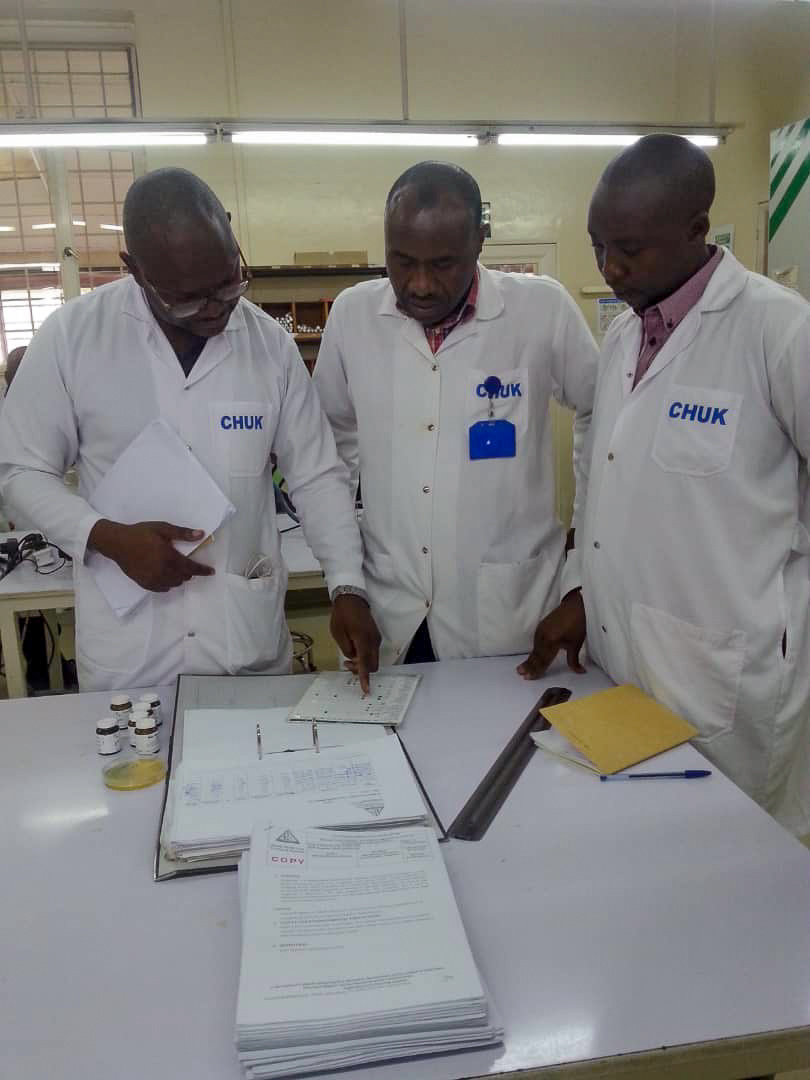
Deaths due to cancer in Rwanda have doubled since 1990. With 50-fold fewer pathologists per capita than the USA, Rwanda lacks a pathology workforce needed to produce consistent and timely diagnoses for cancer patients. Given that late or inaccurate cancer diagnoses are a reliable predictor of adverse outcomes, strengthening diagnostic capacity will be crucial to managing the cancer burden in Rwanda. In 2011, the pathology laboratory at the University Teaching Hospital of Kigali (CHUK) in Rwanda began working toward expanding its diagnostic services to qualify CHUK for official laboratory accreditation. To qualify for accreditation, a laboratory must implement standardized processes that produce accurate and consistent diagnostic results.

In response to the hospital’s plans, BVGH arranged for three pathology and laboratory management experts from MSD* to help the CHUK laboratory staff prepare for accreditation. In particular, they worked with the CHUK team to identify areas for improvement – such as procedure documentation, equipment management, laboratory workflow, and the use of an external quality assurance program. Based on their findings, BVGH, the MSD experts, and the CHUK laboratory staff developed a checklist of steps to complete in order to receive accreditation. Changes implemented include redesigning work shifts to address staff shortages, establishing an equipment management program, creating a competency assessment program, and updating the laboratory’s standard operating procedures. The changes led the laboratory staff to improve their workflow and decrease patient specimen turnaround time from four weeks to ten days.
While in Kigali, the MSD team learned that several pieces of crucial laboratory equipment were either broken or had never been installed. In partnership with the American Society for Clinical Pathology (ASCP), BVGH arranged for an engineer from Kenya to repair CHUK’s broken tissue processor, install its unused grossing station, and operationalize its two cryostats. BVGH subsequently organized for 2019 ASCP Global Health Fellow Dr. Kelsey McHugh to train CHUK staff on the use of the new cryostats. During her stay in Kigali, Dr. McHugh – a cytopathology fellow at the Cleveland Clinic (USA) – delivered lectures covering breast, thyroid, lymph node, salivary gland, and urine cytology and guided CHUK staff’s hands-on practice of fine needle aspiration and slide smearing techniques.
Following the refinement of its workflow and practices, installation and repair of its equipment, and strengthening of its staff’s skills, the CHUK laboratory received a perfect score on a pre-accreditation assessment performed by The Council for Health Service Accreditation of Southern Africa (COHSASA). A subsequent evaluation by the World Health Organization (WHO) resulted in the CHUK laboratory receiving a three-star rating (out of five), a notable improvement from its previous one-star rating.
To celebrate the laboratory’s achievements and encourage continued improvement, Dr. Gervais Ntakirutimana, Head of the Department of Pathology at CHUK, proposed a friendly competition between the laboratory’s seven units. Over the course of two days, each of CHUK’s laboratory units was evaluated against the WHO and COHSASA’s accreditation standards. Those units that met the most criteria received prizes and recognition for their accomplishments. Since then, CHUK has continued to receive evaluations from the WHO. Dr. Ntakirutimana looks forward to receiving accreditation from the WHO, saying, “For us, accreditation means the recognition of CHUK as a pathology center of excellence. A five-star score will facilitate future international partnerships, research, and resources to diagnose cancer patients in Rwanda.”
*MSD is the trademark of Merck & Co., Inc., Kenilworth, NJ, U